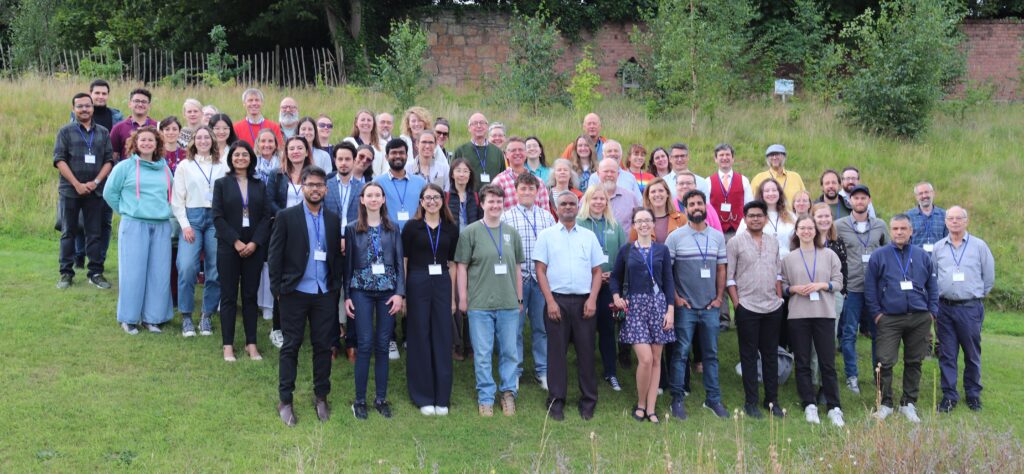
2025 UK LED Meeting at St Andrews
The University of St Andrews had the pleasure of hosting the UK Luminescence and ESR Dating Meeting (UK LED) 2025 from 20–22 August 2025. With delegates attending from over 20 countries representing 5 continents, the conference served as a truly international platform for the exchange of ideas and recent developments in luminescence and ESR dating.
The event commenced with two well-attended pre-conference workshops, held on the day prior to the main sessions. The first, led by Professor Adrian Finch, introduced attendees—particularly students and early career researchers—to the fundamentals of feldspar mineralogy, their varied luminescence behaviours shaped by geological processes, and the types of feldspars commonly found in sediments used in OSL (Optically Stimulated Luminescence) and TL (Thermoluminescence) dating.
The second workshop, led by Dr David Sanderson and Dr Tim Kinnaird, focused on the use of portable OSL systems. Participants explored strategies for levelling and calibrating data across multiple pOSL readers, and how these instruments can be used collectively to generate 2D and 3D luminescence stratigraphies. . A short field trip to St Andrews beach added a local flavour, as participants collected sand samples and assessed their luminescence behaviour in real-time using the portable equipment. The day concluded with a wine reception and ice-breaker session, setting a warm, collegial tone for the days to follow.
The day before the main conference began, two pre-conference workshops offered attendees the chance to engage in hands-on learning. The first workshop, led by Prof Adrian Finch, focused on feldspar minerals—a foundational topic for students and early career researchers. Participants explored the basic mineralogy, luminescence behaviours shaped by geological histories, and common feldspar types found in sediments used for OSL (Optically Stimulated Luminescence) and TL (Thermoluminescence) measurements. The second workshop, led by Dr David Sanderson and Dr Tim Kinnaird, showcased the use of portable OSL (pOSL) systems. This session featured multiple pOSL readers, highlighting strategies to standardise measurements across instruments and demonstrating how data integration from various devices could produce large-scale profiles and 2D/3D luminescence stratigraphies using the portable readers.
The main conference featured nine sessions, covering a wide range of themes from the fundamentals of luminescence and ESR dating to their applications in geoarchaeology, environmental reconstruction, and sediment chronology. Notably, many of the sessions were chaired by students, offering them valuable professional development and helping to foster an inclusive, collaborative atmosphere.
Day 1 included talks on case studies demonstrating the application of dating techniques across diverse geographic regions including India, Australia, France, and Laos. There were further sessions on feldspar-based methods and rock surface luminescence dating, and dosimetry and dose rate modelling. Day 2 comprised four sessions, beginning with a geoarchaeological focus, followed by sessions on fundamental luminescence processes and recent methodological advances. The day also included a well-received discussion on recent developments in ESR techniques, followed by a guided tour of the ESR laboratory facilities at St Andrews. The evening concluded with a conference dinner at Lower College Hall, followed by a ceilidh—a traditional Scottish dance event that offered a memorable cultural experience for all attendees. Day 3 concluded the conference with sessions on the application of OSL techniques in coastal and marine environments, an area of growing interest in the field. In addition to oral presentations, 26 posters were presented, covering a broad spectrum from fundamental research to applied studies. Two students were recognised for their outstanding contributions: Best Oral Presentation: Serban-Constantin Grecu from Babeș-Bolyai University, Romania) won prize for the best oral presentation, and Joe Winzar from Aberystwyth University for the best poster presentation.
The conference was marked by lively scientific exchange, interdisciplinary engagement, and a strong sense of community. From foundational discussions to cutting-edge methods and collaborative exploration, UK LED 2025 successfully highlighted the vibrancy and growth of luminescence and ESR dating research.
The organisers extend their sincere thanks to all participants and look forward to future opportunities for collaboration and exchange within this dynamic research community.
Dr Aayush Srivastava and Dr Tim Kinnaird